
Consideration of Corporate Disaster Preparedness – In-house Buildings without Disaster Preparedness Centers –


※This article is machine translated.

On January 1, 2024, a major earthquake measuring up to intensity 7 on the Japanese scale occurred on the Noto Peninsula in Ishikawa Prefecture. The earthquake caused extensive damage due to collapsed houses, landslides, tsunamis, and fires.
In this issue, we would like to review our response on the day of the Noto Peninsula earthquake and report on what disaster prevention measures are currently in place at Cocone.
Our response on the day of the Noto Peninsula earthquake
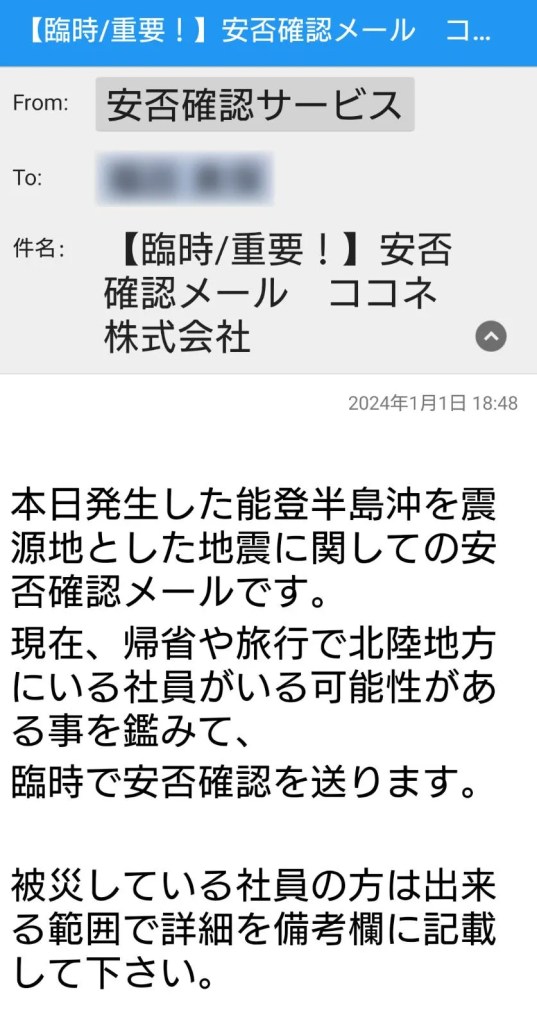
Two general managers came to work in an emergency and sent out a safety confirmation e-mail to all employees.
We have contracted with an external service that automatically sends out e-mails to confirm the safety of our employees in the event of a disaster.
Conditions for sending out safety confirmation e-mails are in Tokyo, Kanagawa, Chiba, Saitama, Ibaraki, Tochigi, and Gunma prefectures,
(1) In the event of an earthquake of intensity 5 or higher
(2) When a tsunami warning of 30 cm or more is issued
(iii) When a special warning is issued
The following information will be confirmed: whether or not the person and his/her family members are injured, the location of the disaster, whether or not he/she is able to come to work, and the means of transportation if he/she is able to come to work.
However, since the earthquake occurred on “New Year’s Day,” two employees from the General Affairs Department came to the office on the evening of January 1 to manually send out a safety confirmation e-mail, taking into consideration the possibility that some employees were returning home or on vacation.
Status of employee responses to safety confirmation e-mails
According to the General Affairs Department, 181 people responded within 10 minutes of the safety confirmation e-mail sent to 570 people, while 313 people responded within one hour, or about 55%.
In conjunction with our biannual disaster drills for all employees, we have conducted several simulated safety confirmation e-mail transmission tests that simulate an actual disaster.
The response rate immediately after the earthquake was 55%, which was lower than during the test, but the response rate within 24 hours was almost 100%, perhaps because some employees were not aware of the e-mail because it was New Year’s Day (during vacation). *See figure below.

*The past two (6/27/2022 and 11/8/2023) were test transmissions with advance notice.
Next, I would like to confirm what other measures our company has in place to respond to a disaster.
In-house building with no emergency preparedness center
Since we operate in our own building without a disaster prevention center, we must take the initiative to ensure our own safety in the event of a disaster.
For this reason, an in-house fire prevention and disaster prevention organization, the “Self-Defense Fire Brigade,” has been formed to play a central role in evacuation instructions and emergency life-saving activities in the event of a disaster. Led by the General Affairs Department, there are approximately 62 personnel selected from each department (as of February 2024).
The “Self-Defense Fire Brigade” conducts drills in first aid and emergency treatment in preparation for disasters, so that when the time comes, they are always prepared to unite employees and act quickly.
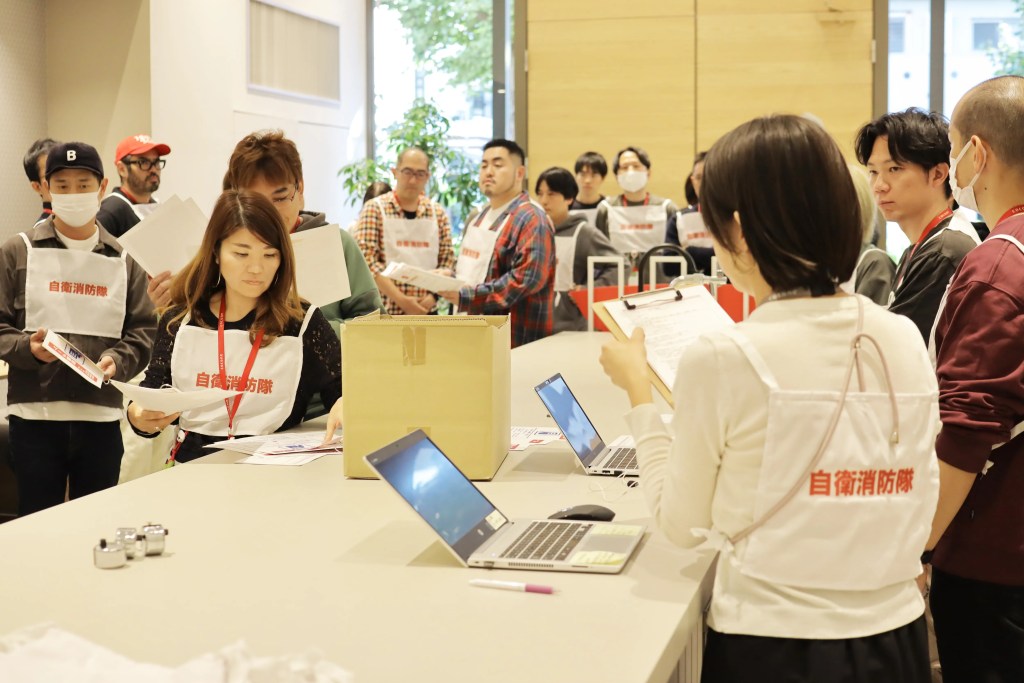

Employees participating in in-house AED training face real-life rescue scenarios.
Last September, we held an AED training session and a first aid training session for members of the self-defense fire brigade, with an active member of the fire department as instructor.

And recently, an employee who attended the course was faced with an actual situation where he encountered a person in need of first aid, and although he did not use an AED, he did provide cardiac massage.
According to the employee, “We were able to respond calmly because of the training we had done.
Stockpile at least one day’s worth of supplies at each desk and two days’ worth in the basement warehouse.
When a disaster occurs, it is expected that a large number of people will have difficulty returning home. In order to prevent the occurrence of secondary disasters such as crowd avalanches and other disasters caused by large numbers of people returning home at the same time, and to prevent the obstruction of emergency services, the “Tokyo Metropolitan Ordinance on Measures for People Having Difficulties Returning Home” (enacted March 2012, enforced April 2013) explicitly requires companies to stockpile drinking water, food, blankets, and other supplies for employees to keep them in their offices and other facilities to curtail the simultaneous return of people and to keep them on standby in the facilities. The ordinance also requires companies to stockpile three days’ worth of drinking water, food, blankets, and other supplies for their employees to prevent them from returning home en masse and to keep them inside offices and other facilities.
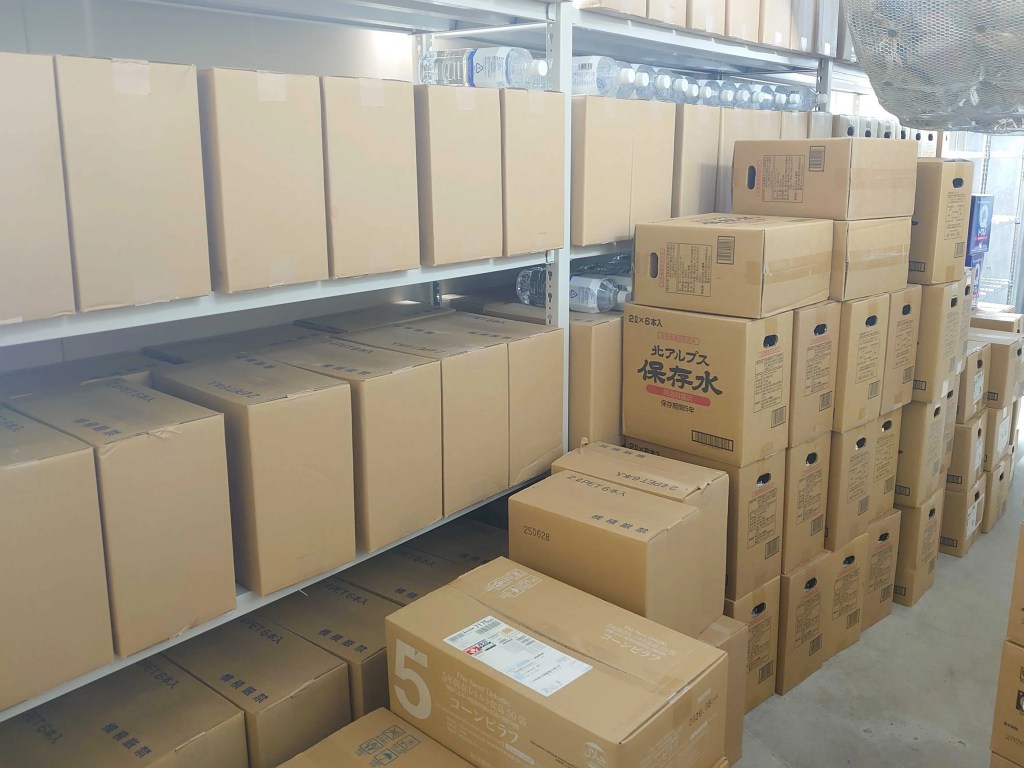
We have a disaster prevention bag at each desk containing one day’s worth of necessary supplies, and we store the remaining two or more days’ worth of stockpiles in a warehouse located in the basement of our office. These stockpiles are distributed to employees as needed by a ” stockpile management team ” organized in the event of a disaster.
BCP is being revised in accordance with the company’s current situation.
Our priorities in the event of a disaster,
(1) Take action to save lives.
(2) Establish a disaster response headquarters and a self-defense fire brigade to ensure the safety of the company.
(3) Gather information on the damage in the neighborhood and the operation of transportation systems in order to make the decision to come to work or go home.
(4) Take action for business continuity
The above is set forth above.
We are aware of the actions we must take to continue our own business while putting the safety of our employees and their families first, and we had a BCP (Business Continuity Plan) in place for our office environment, number of employees, and other current conditions of the company. As soon as it is completed, the plan will be implemented after a decision is made by experts. As soon as the plan is completed, we plan to put it into effect after receiving a decision from experts.
Natural disasters, not limited to earthquakes, are difficult to predict when and on what scale they will occur. It is possible to be hit by a disaster while commuting to work or during working hours.
While placing the highest priority on human life, we must act to minimize the impact of natural disasters, resume important operations as quickly as possible, and take action to ensure business continuity. To this end, we believe that it is essential for companies to do what they can to raise awareness of disaster prevention through daily preparations against disasters, as well as to make their employees aware and recognize the importance and significance of such preparations.
Finally, we would like to express our deepest condolences to the victims of the Noto Peninsula earthquake and our deepest sympathies to all those affected by this tragedy. We sincerely pray for the safety of everyone in the affected areas and for the earliest possible recovery and reconstruction.
See also these articles
Conducted disaster drills for all employees by a 65-member self-defense fire brigade.
Two instructors from the Setagaya Fire Department were invited to conduct a self-defense fire drill!
Enjoy and be prepared! Cocone’s Disaster Preparedness Drill


