
Magazine Software Design January 2024 issue: Interview “‘C.A.T. Club’ incorporating the latest technology” with Donggun Shin and Jeongtaek Kim [ Part 1 ]


※This article is machine translated.

Exploring Cocone’s Engineering Capabilities for Global Challenges
Top-level performance in the world’s favorite digital world
Part 7: “C.A.T. Club” Incorporating the Latest Technology
Cocone’s search for a global challenge has led to the creation of C.A.T. Club, a 3D-based collection of digital art toys. The service allows users to enjoy their own personal collection of art toys as they explore the field, and since the app was just released in September 2023, it features the latest technologies such as AWS Fargate and MongoDB Atlas. For more details, we will talk to Mr. Donggun Shin and Mr. Jeongtaek Kim of Cocone Global Studios.
![Magazine Software Design January 2024 issue: Interview "'C.A.T. Club' incorporating the latest technology" with Donggun Shin and Jeongtaek Kim [ Part 1 ]](https://cocone.co.jp/wp-content/uploads/2023/12/202401dd_lt-1024x576.jpg)
– Please introduce yourself.
My name is Donggun Shin, and I am the Client Tech Leader of the C.A.T. Club Project Development Team at Cocone Global Studios. I have about 20 years of experience in the game industry and joined Cocone about 10 years ago. I mainly work on client development for mobile apps.
My name is Jeongtaek Kim and I am the Server Tech Leader of the Global Studio C.A.T. Club Project Development Team. I joined Cocone 10 years ago and have worked on numerous projects.
Reflecting on our strengths to challenge the global market
– Please tell us briefly about the C.A.T. Club.
Shin: “C.A.T. Club (Collectible Art Toys Club)” is a service that allows users to explore a virtual space to discover, collect and display 3D digital art toys. In the real world, we display our favorite figures on shelves, don’t we? This is Cocone’s second 3D service, and the first to be based on 3D rather than 2D. While Cocone’s previous offerings have focused on character coordinating play (CCP), in which users dress up their alter egos, C.A.T. Club will focus on collection and display, rather than dress-up.
Kim: Global expansion is another feature. There has been global development in the past, but the main target was the Asian region, where “kawaii” is favored. This time, the main target country is the U.S. The atmosphere of the characters, overall UI, sound, infrastructure structure, etc. have been adjusted to match the target country. The release date is September 4, 2023, which is actually the anniversary of Cocone’s founding.
– How did it come about?
Shin: Cocone is always trying to take on new challenges. For example, we are working on AI-based services and blockchain technology development at our group companies. The next challenge we chose was to expand globally. We decided to challenge the world with services through the digital world, which has been well received in Japan.
Kim: I thought about what our strengths are that can be used worldwide. I thought that we are second to none when it comes to the technology and know-how to create high quality avatars and digital items, and to provide a digital world where people can enjoy self-expression and communication.
– How did you proceed with the development?
Shin: Initially, we developed a prototype based on “Pokepia”, CCP’s 3D service that had already been launched. However, since “C.A.T. Club” is not CCP’s main service, we decided it would be tough to divert it as is. We diverted some of what could be diverted, but it was mostly scratch development. The front-end was developed in Unity.
Kim: The backend is based on Kotlin and emphasizes productivity. The framework is Spring Boot.
Shin: The project was initiated around the end of 2022. Initially, the project will be evaluated in prototype form, and full-scale development will begin in 2023.
Challenges in developing 3D-based applications
– How does being 3D-based affect your development?
Shin: 3D tends to increase the size of assets, and the production process is also time-consuming. Since many of the previous applications we have used as a base are 2D, we are reworking them in various ways. The actual items downloaded by customers are not that large, but the work data that the designers use to create the items is quite large. To prevent app bloat, we have separated the workspace between the asset and app projects. This also makes it easier to release the product.
Kim: The characters look very different.
Shin: We use Unity’s URP (Universal Render Pipeline) for rendering; URP is versatile, lightweight, and easy to implement new features.
In 3D services, the representation of light is also an important element in immersing the viewer in the world. The world of “C.A.T. Club” also incorporates the passage of time, but the progression of time is not the same as in the real world, but rather an eight-hour cycle. Even those who play at roughly the same time each day can experience the various worlds of day and night.
– What challenges do you face?
Shin: Regarding Unity’s development tools, we are gradually increasing the number of functions necessary for the “realistic 3D expression” that is so important for “C.A.T. Club”.
– What are the characteristics of the back end?
Kim: As mentioned earlier, the previous global deployment services were mainly targeting the Asian region, so the servers were set up in the Singapore region of AWS. However, this time, since the main target is the U.S., the server is set up in the Northern Virginia Region (us-east-1) (Figure 1). This is the first time this has been done for a Cocone application.
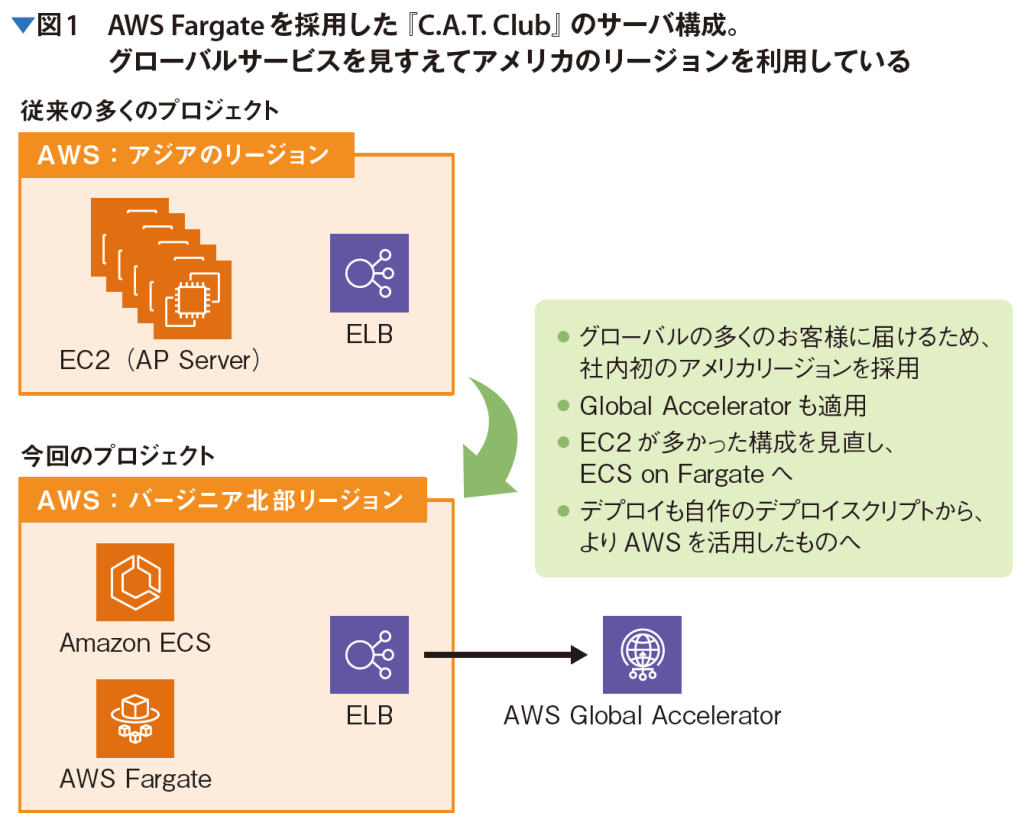
Shin: At the moment, development is done only in Tokyo (Japan), while the U.S. is mainly in charge of legal and marketing.
Kim: Communication latency becomes a problem when the distance is long, but we have included Global Accelerator to make it possible to play comfortably.
Shin: You also use containers, right?
Kim: Until now, Cocone has had services that adopted ECS (Container Orchestration Service) with Amazon EC2 and services that started using AWS Fargate in the process, but “C.A.T. Club” is the first service to use AWS Fargate from the beginning. Fargate frees us from the management of ECS instances, which makes management much easier.
To be continued in Part 2.
[Related Article]

Click here for a list of engineering jobs


